


2025 Honda Pilot near Smithtown, NY
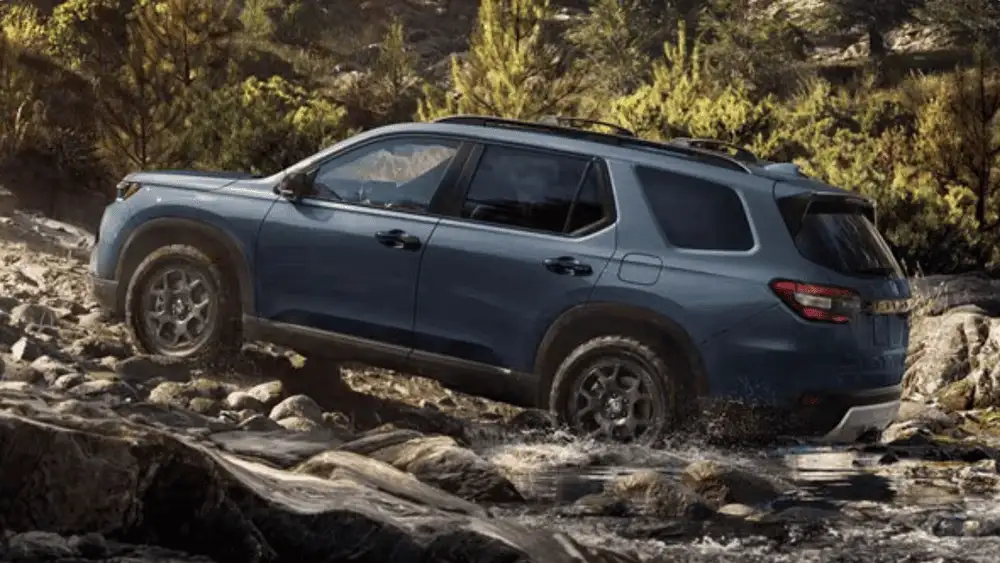
The 2025 Honda Pilot is engineered as a midsize SUV with a strong emphasis on mechanical reliability, structural integrity, and comprehensive system integration. Its design supports multi-row passenger capacity, high payload versatility, and stable towing performance while maintaining controlled handling and predictable driving behavior. The model reflects a balanced approach to power delivery, drivetrain adaptability, and safety system integration, making it suitable for both urban use and extended travel. Each component is configured to function within a unified platform that prioritizes durability, efficiency, and operational consistency.
Powertrain Architecture and Output Control
The 2025 Honda Pilot is powered exclusively by a 3.5-liter V6 engine with a total displacement of 3,471 cubic centimeters. This naturally aspirated power unit produces 285 horsepower at 6,100 rpm and generates 262 lb-ft of torque at 5,000 rpm. The engine operates with a 24-valve dual overhead camshaft configuration and employs Dual Variable Timing Control to manage valve timing across varying engine loads. A compression ratio of 11.5:1 supports efficient combustion while maintaining compatibility with regular unleaded fuel.
Direct fuel injection enhances throttle response and fuel atomization, contributing to consistent output across the power band. Variable Cylinder Management allows selective cylinder deactivation during low-load driving conditions, reducing fuel consumption without interrupting drivetrain operation. The Eco Assist system provides feedback to promote efficient driving behavior through throttle modulation and system optimization. Idle Stop functionality further reduces unnecessary fuel use during extended stationary periods.
Noise and vibration control is managed through Active Control Engine Mounts and Active Noise Cancellation technology. These systems reduce drivetrain resonance and cabin noise by counteracting vibration frequencies generated during engine operation. A direct ignition system with an immobilizer supports consistent cold starts and vehicle security. Emissions compliance meets LEV3-SULEV30 standards as certified by regulatory authorities.
Transmission Engineering and Drivetrain Configuration
Power delivery is managed by a 10-speed automatic transmission equipped with shift-by-wire technology. The transmission incorporates closely spaced gear ratios to maintain optimal engine speed during acceleration, highway cruising, and towing. Paddle shifters mounted on the steering wheel allow manual gear selection when required. A final drive ratio of 4.167 supports torque multiplication under load and contributes to controlled towing performance.
The 2025 Honda Pilot is available in both front-wheel-drive and all-wheel-drive configurations. The available second-generation Intelligent Variable Torque Management all-wheel-drive system dynamically distributes torque between the front and rear axles, as well as laterally across the rear wheels. This system improves traction on uneven surfaces and during inclement weather by continuously adjusting torque allocation based on wheel slip and vehicle input.
Trail Torque Logic is integrated into select all-wheel-drive configurations, optimizing power delivery during low-speed operation on loose or uneven terrain. Multiple integrated drive modes allow the driver to adjust throttle response, transmission behavior, and traction calibration. Available modes include Normal, Econ, Sport, Snow, Tow, Trail, and Sand, depending on drivetrain configuration. Maximum towing capacity reaches 5,000 pounds on all-wheel-drive models and 3,500 pounds on front-wheel-drive variants when properly equipped.
Structural Design and Chassis Dynamics
The chassis of the 2025 Honda Pilot is constructed using a reinforced unit-body platform supported by Advanced Compatibility Engineering body structure design. This structural approach enhances energy distribution during collisions while maintaining rigidity for improved handling and ride stability. The platform supports consistent weight distribution across both drivetrain configurations.
Front suspension is managed by a MacPherson® strut design, while the rear utilizes a multi-link suspension system. This combination balances ride comfort with lateral stability, particularly during cornering and load transfer. Electric power-assisted rack-and-pinion steering provides a steering ratio designed for controlled responsiveness, with approximately three turns lock-to-lock. The turning diameter is 37.8, supporting maneuverability in confined spaces.
Braking performance is supported by power-assisted four-wheel disc brakes, featuring ventilated front rotors and solid rear rotors. Electronic Brake Distribution and Brake Assist systems modulate braking force based on vehicle load and deceleration demand. Vehicle Stability Assist with traction control supports directional stability during sudden maneuvers or reduced traction conditions. Hill Start Assist and Hill Descent Control further contribute to controlled operation on inclined surfaces.
Exterior Dimensions and Functional Geometry
The exterior dimensions of the 2025 Honda Pilot reflect its midsize classification while supporting three-row seating. Overall length measures 200.1 inches, with a wheelbase of 113.8 inches. The vehicle width is 78.5 inches, providing a wide stance for improved stability. Overall height varies slightly by trim and drivetrain configuration, with available ground clearance reaching up to 8.3 inches on select all-wheel-drive models.
Approach and departure angles are engineered to support light off-road operation while maintaining bumper clearance during urban driving. Track width remains consistent across most configurations, contributing to predictable handling. Exterior components such as roof rails, active shutter grilles, and underbody skid plates on select trims serve both functional and protective purposes. LED lighting is utilized for headlights, daytime running lights, brake lights, and fog lights, ensuring consistent illumination and long service life.
Acoustic laminate glass is incorporated into the windshield and front side windows on higher trims, reducing exterior noise intrusion. Power-adjustable side mirrors with heating and integrated turn signals support visibility in changing weather conditions. Rear privacy glass and intermittent rear wipers contribute to cabin comfort and visibility management.
Interior Capacity and Configurable Space
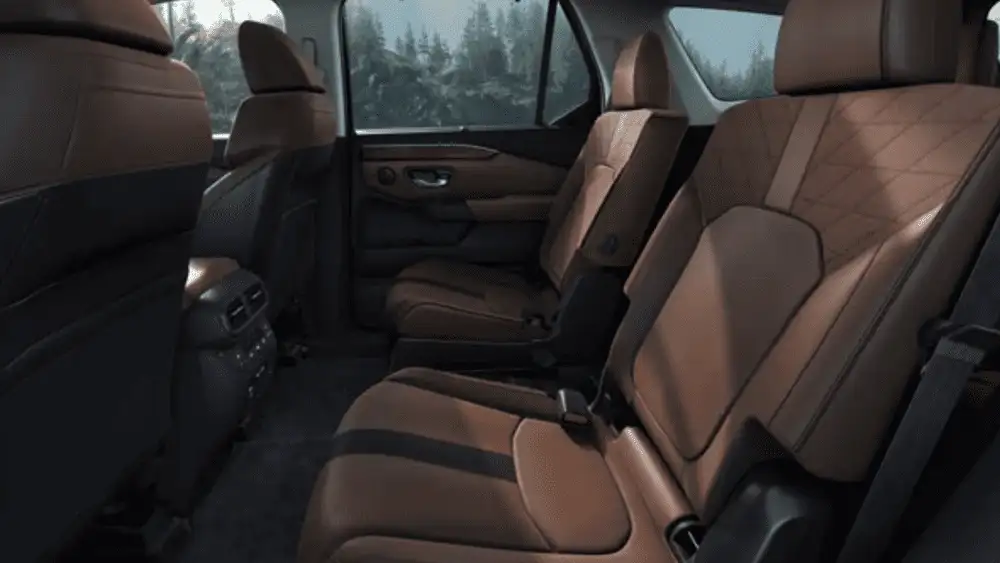
Interior design emphasizes passenger accommodation and cargo adaptability. Seating capacity varies between seven and eight occupants depending on drivetrain and second-row configuration. Second-row seating includes flat-folding functionality with multiple split configurations. Select trims feature a removable second-row middle seat, allowing flexible conversion between bench seating and open access to the third row.
Headroom and legroom measurements provide sufficient space across all three rows, including 32.5 inches of third-row legroom. Total passenger volume is 158.4 cubic feet on most configurations. Cargo capacity measures 18.6 cubic feet behind the third row and expands to 87 cubic feet with the second and third rows folded flat. Maximum cargo volume is 113.7 cubic feet depending on trim and seating configuration.
Interior storage solutions include an in-floor cargo well, lockable glove compartment, multi-function center console, and multiple cup holders distributed across all seating rows. Rear-seat heater ducts support even climate distribution. Tri-zone automatic climate control with humidity management and air filtration maintains consistent cabin conditions for front and rear occupants.
Digital Systems and Connectivity Integration
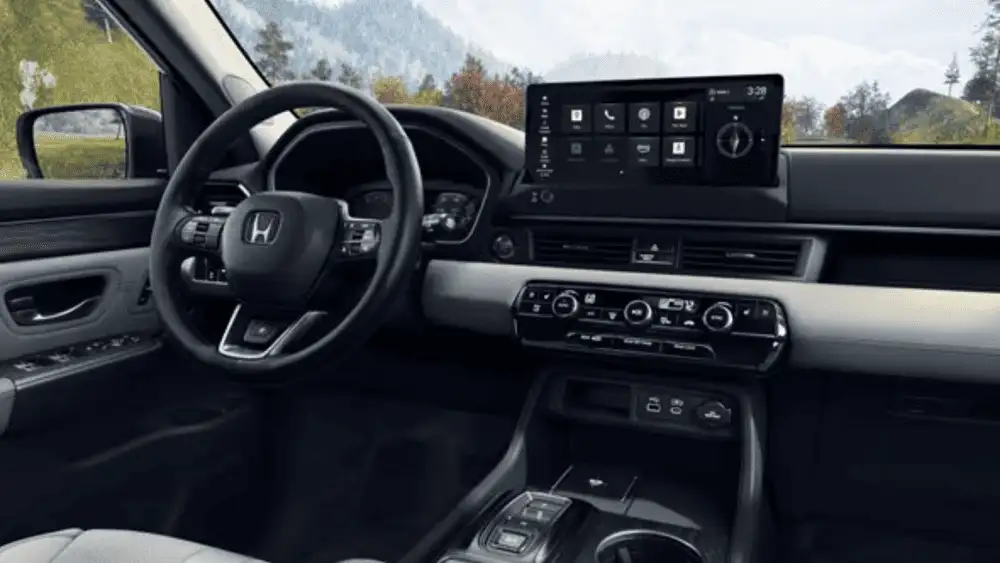
The 2025 Honda Pilot integrates multiple digital interfaces to support driver awareness and system monitoring. Instrumentation includes a 10.2-inch digital instrument cluster. Center-mounted touchscreens measure 12.3-inch and provide access to vehicle settings, navigation, and connectivity features.
Apple CarPlay® and Android Auto™ compatibility is standard, with wireless functionality available on select trims. Bluetooth® hands-free calling and audio streaming are integrated across all configurations. USB Type-A and Type-C ports are distributed across all three rows, supporting device charging and media connectivity. Higher trims include wireless phone charging, Wi-Fi hotspot capability, and multi-zone audio functionality.
Available audio systems range from a 245-watt configuration with seven speakers to a premium Bose® system with twelve speakers and a dedicated subwoofer. Voice recognition, satellite-linked navigation, and in-cabin communication systems such as CabinTalk support driver interaction and passenger coordination.
Comprehensive Safety and Driver Assistance Technologies
Every 2025 Honda Pilot includes the Honda Sensing® suite of safety and driver assistance systems. This package incorporates Collision Mitigation Braking, Road Departure Mitigation, Forward Collision Warning, Lane Departure Warning, and Lane Keeping Assist. Adaptive Cruise Control with low-speed follow supports consistent spacing in highway and congested driving environments.
Blind Spot Information and Cross Traffic Monitor systems enhance situational awareness during lane changes and reversing. Traffic Sign Recognition displays detected signage within the instrument cluster. Driver Attention Monitoring evaluates steering input to identify potential fatigue. Parking sensors, multi-angle rearview cameras, and available multi-view camera systems assist with low-speed maneuvering and trail navigation.
Passive safety features include advanced front airbags, side airbags, and three-row side curtain airbags with rollover sensors. Seatbelt systems incorporate automatic tensioning and reminders for all seating positions. Child safety systems include multiple lower anchors and tether points across the second and third rows.
Schedule a Test Ride Today
Drivers interested in evaluating the mechanical refinement, drivetrain capability, and integrated safety systems of the 2025 Honda Pilot may benefit from a scheduled test drive. Experiencing the V6 power delivery, 10-speed transmission response, and available all-wheel-drive performance provides a clearer understanding of how these systems operate together. A test drive also allows firsthand evaluation of interior space, visibility, and digital interface usability across various driving conditions. Those seeking a structured and informative driving experience can arrange an appointment through Huntington Honda near Smithtown, NY. This approach allows prospective drivers to assess how the technical configuration of the 2025 Honda Pilot aligns with daily driving and long-term usage needs.